Tuesday, March 28, 2023

First Real Autumn

 It’s been so many years since I enjoyed fall.  In Florida, it was the time when you might be able to wear a sweatshirt for about an hour in the morning before giving up and peeling it off.  It was also a good time to work outside without swimming in your own clothes from accumulated sweat.  The red maples would turn, if the days were cold enough, but it was subdued and mild.  It was only a mere suggestion of fall.  

Not so here in Minnesota.  The most intense heat withdraws in September.  October gradually cools and the show begins in the southern part of the state and gradually moves north.  November is when the snow arrives and the leaves disappear under a frosty blanket.  Our farm put on a proud show for the season.  True Autumn has been missed.  


Summer of Kittens

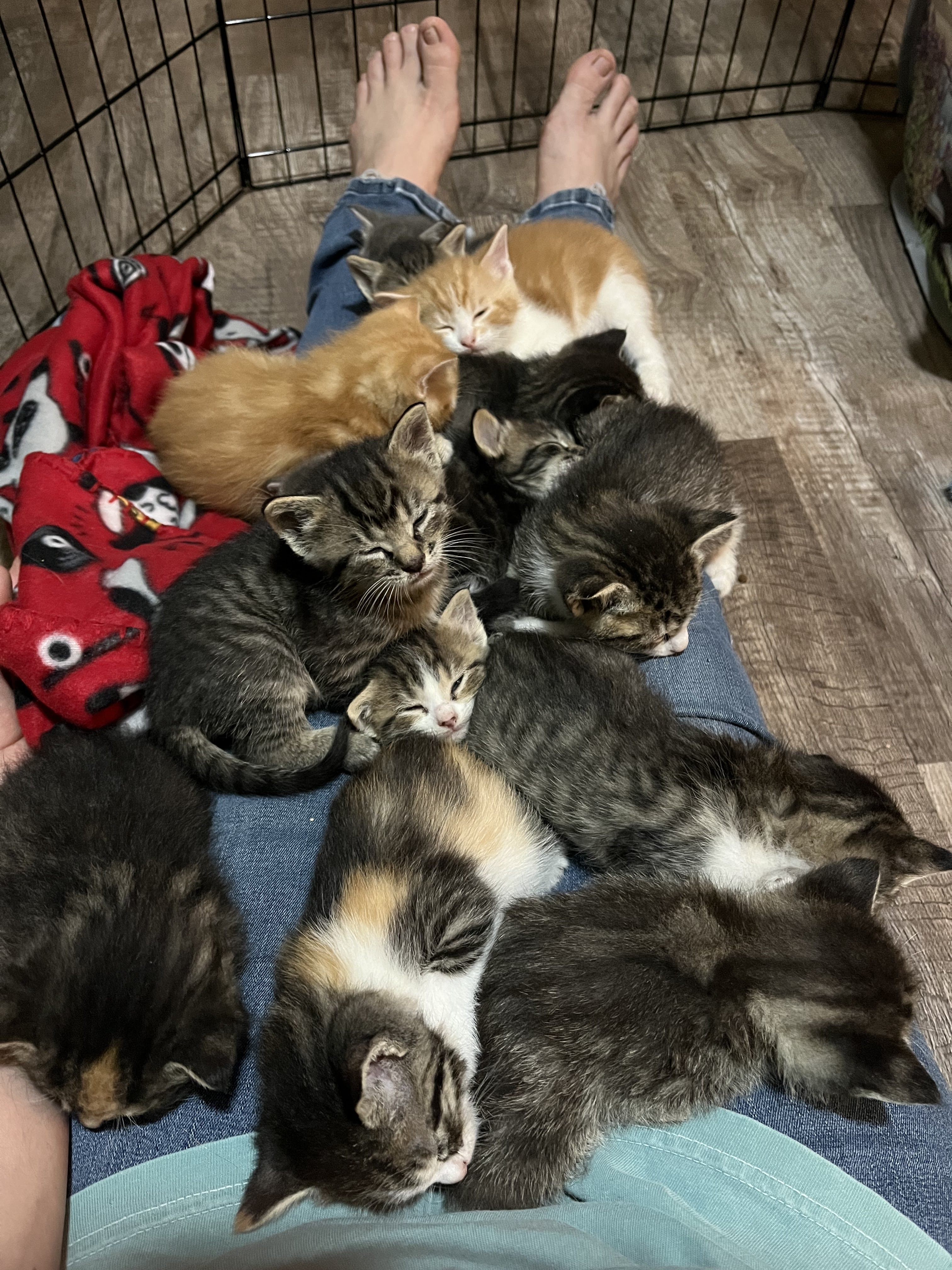
 Looking back, I’m not sure how we did it.  Due to the aftermath of Covid, shelters and rescues had no room.  Funds for spaying and neutering were depleted.  Somehow, we weaned the entire brood together, fed them three times per day, cleaned their litter boxes twice per day, and gave them attention, toys, and started them on solid foods.  They lived in a spare room in the basement.  The mother cats were all locked up until, they dried up, and then were spayed.  Two went to live with a neighbor as her barn kitties (Victoria and Louisa) and Polly stayed with us and became Ralph’s best friend.   

At the height of the kitten madness:


Meanwhile, we put up flyers and screened adopters for the fourteen kittens.  We assisted the aid of a local cat rescue when no more suitable adopters were found (we insisted on inside homes).  We became the foster family for the three remaining kittens and the rescue selected the homes.  It worked out great for two kittens, but one last kitten, Miggy, had no takers.   He went to another foster family.  Meanwhile, we had to put down two of our indoor kitties.  The first was Jacob, the disabled cat that we had rescued as an abandoned kitten and needed twice daily medication.  His neurological injuries were getting the best of him.  The other was our sweet older cat, Tiger, whose hips were going and her health was too fragile for corrective surgery.  Our house seems suddenly empty with the kittens off to their new lives and two of our own cats gone.  We still had Rocky and Audrey (the elderly cat that stayed in the hotel room with us during our trip north).  Miggy, the one remaining kitten still didn’t have a new family.  We brought him back home and adopted him ourselves.  He cheered us all up.  At the end of summer, we had one new barn cat and one kitten to keep for ourselves.  


14 Kittens!

 In my last post, I mentioned three kittens from Polly and five kittens from Louisa.  That’s clearly eight.  What in the world would make me suggest that eight would actually become fourteen?  Ah yes, cat math.  If you have three barn cats on a farm, what is the likelihood that all three are female? And pregnant?  Apparently, 100%.  

The feral gray tabby was elusive but I needed all three fixed in order to carry on without future kittens.  We dropped food for it by the outdoor cat shelter left behind, but it would zoom away if we came within ten feet.  Until one morning.  It rushed at me when I got too close to the shelter.  I pondered this for a minute and tried again.  Same thing.  Rabies?  No, it wasn’t even hissing.  Suspecting something, I loaded a trap and waited.  I brought our son out for evening feeding and the cat was not in the shelter.  A quick peek confirmed my suspicions.  He was absolutely delighted.  He started trying to guess how many more kittens were in there.  Meanwhile, I moved Louisa and Polly into one crate with an attached pen that would keep the kittens in, but the moms could explore the garage during feeding times.  I had one chance to catch this last feral cat.  She was no doubt watching me and would probably feel threatened enough to move her kittens.  We set up the second crate for her in the garage.  The next morning, during her normal feeding time, I placed the trap right in front of her exit from the shelter.  We put wet food inside as bait.  She peeked out, clearly alarmed, hesitated, and then SNAP!  She was in and very unhappy.  I dribbled flea control on her back to confirm to her that I was a horrible person.  Our son had the job of reaching in the dark cat shelter and pulling out the kittens one by one.  So, as you’ve no doubt guessed, they kept coming until six of the little monsters were in the bucket.  We carried the feral cat in the cage, who we named Victoria, and her six offspring into the garage.  Her kittens were named after Queen Victoria’s children.  

With these descriptions, pictures are a must.  First the trapping of Victoria.


Next, Victoria’s babies.  We had two different photo sessions several weeks apart because Victoria was difficult to tame down.  She eventually let us pet her.


The New Barn Cats and Their Kittens

 There is an empty grain silo on our new farm.  And two female barn cats that are pregnant.  I moved two cat shelters, left behind by the previous owner, into the grain silo and managed to get ahold of the cats to set them up in the enclosed grain silo where they could have their babies and I could keep them safe until they could be spayed.  It was the perfect plan.  At first.  One of the kitties, a beautiful solid gray we named Louisa, was attending to three newborns within a few days of locking her up.  It was early May (May the Fourth be with you day), so we named her three kittens (two males and a female) Han, Luke, and Leia.  Two of the kittens were orange tabbies and one was calico.  That seems a little odd from a gray mother.  The other pregnant kitty was a polydactyl orange female tabby we named Polly.  She kept trying to push in between Louisa and her kittens.  Finally, I set up an extra large dog crate on the garage (the grain bin was getting hot during the day) and moved Louisa and her kittens. However, when I picked up Polly (she was frantic when I took the others away) I noticed her belly was empty and her teats were full.  Oh dear.  Someone stole kittens.  I set up another crate in the garage and reunited Polly with her offspring and Louisa had her own crate.  Three days later, Louisa had her own litter of five kittens!   Our son named her kittens after friends at his old school.  The two mother cats rubbed at each other through their respective crates.  Perhaps we could combine the two families soon.  


Polly’s kittens:


Louisa’s kittens:


Settling In 4/14/22

 The house was perfect.  The cow barn was ready for Fiona, but the fences were not tight enough for the goats.  Fiona would need a friend soon.  The three sided shelter provided electricity for heated water buckets (which we bought locally that first day) and shelter for the large animals.  The two horses had been professionally shipped to boarding barn here in Minnesota a week before our trip, so they were comfortable until it was time to get them.  Meanwhile, I built a temporary pen out of the wind for the goats and mini donkey and put together the corral panels under the open shed for the horses to come home to.  A roaring creek flowed on the property in a beautiful ravine surrounded by forest.  Wood duck nests awaited inhabitants.  Winter was two weeks longer this year, the locals said.  They apologized for the wind as well.  No need.  It was welcome after 15 years of stifling heat in the South.  

One unanticipated surprise was that there were already some barn cats.  Two pregnant female barn cats, to be precise.  They were wily, but somewhat tame.  A third, gray tabby was feral.  A fourth orange cat was spotted, but disappeared before we could determine if it was male or female.  We had brought Ralph, our barn cat, but he didn’t know this new place, so he was locked up in the workshop (heated) until he was ready to explore.  I started looking for ways to trap the barn cats and planned what to do when I did.  

I found a weanling heifer to purchase locally as company for Fiona and to start building a cow herd again.  Fiona was thrilled with her new friend.  We named her Violet.  She was an early calf born when it was still very cold.  As a result, she is missing the tip of her tail from frostbite.  


Missouri to Minnesota 4/13/22

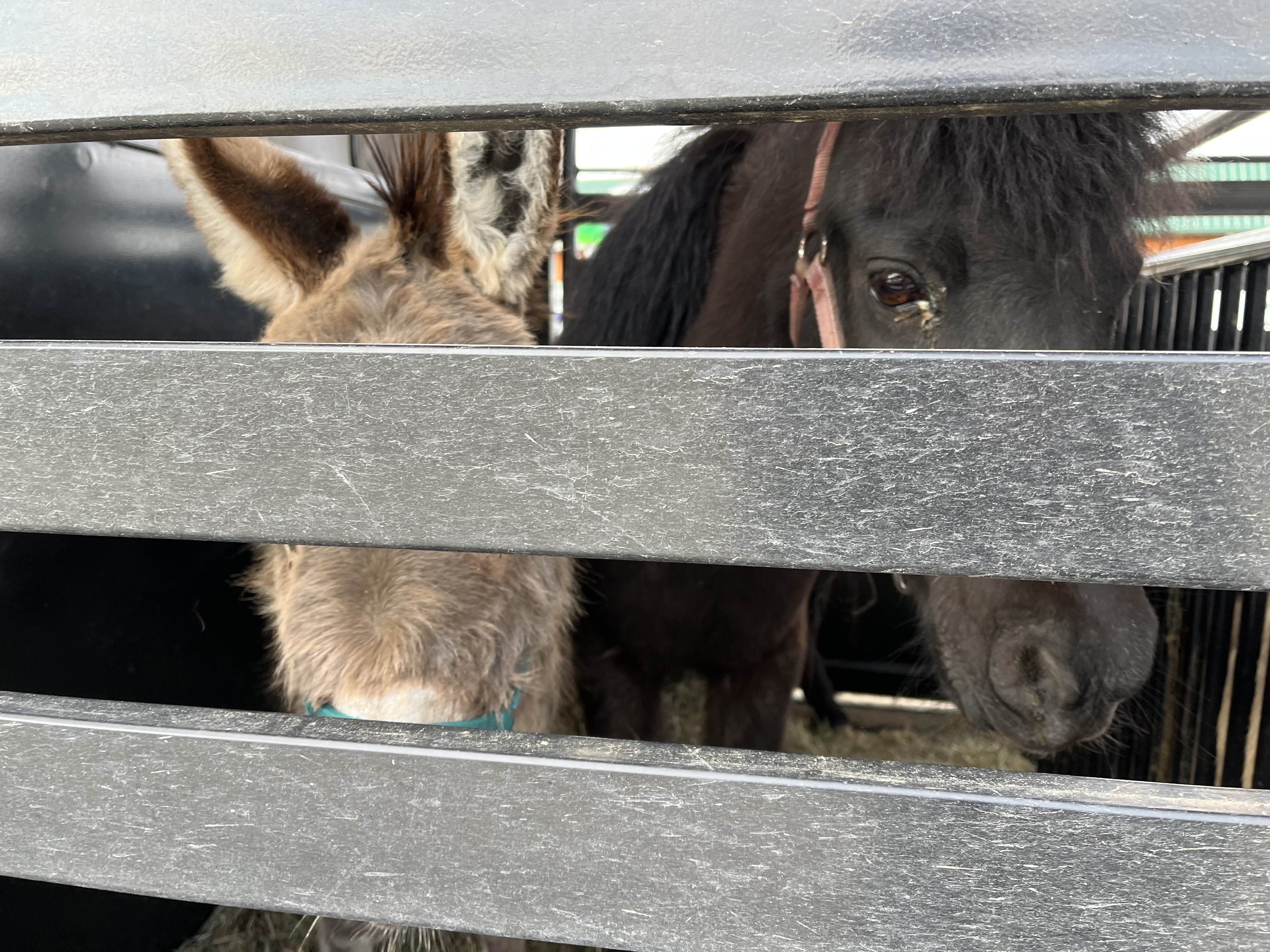
 It was a cold, blustery morning when we left Kirksville and the temperature would only drop further as we headed north.  Our thoughts were on getting the goats, pony, cow, and donkey to warm stalls in Minnesota.  The goats and donkey were in the front of the trailer where they could avoid much of the wind.  Goats are most susceptible to getting chilled.  The cow and pony still had some pretty thick coats and appeared much more comfortable.  The map program led us on dirt roads heading north into Iowa.  It was slow going over old winter ruts along rural roads.  I doubted my map program and checked the direction to ensure we were heading the right way.  Eventually, it dumped us onto a secondary paved road and then joined a highway.  The differences in the landscape from Florida to the northern Midwest were as if we were traveling backwards from full spring through early spring, and then into late winter.  The trees were still bare and very little green, even from ditches along the highway.  Thankfully, despite being in the twenties, there was no snow on the ground and zero ice.  It was dry, cold, and sunny.  It reminded me of northern Colorado and the seemingly constant winds that would blow across our little front range town.  It wasn’t quite as dry as the squeezed out winds that came off the mountains, but the slightly higher humidity made it more cruel.  Of all the welcome signs of the many states we had crossed into, Minnesota’s was the most attractive.  Partly because we were almost home, and partly because it used native rock.  

We were here.  The land of Vikings and funny phrases.  Hot dishes and walleye.  Snow, prairies, lakes, and rivers.  As a graduate student in ecology, I looked at unfamiliar forms and realized just how much I had to learn.  Memorizing new Latin names of plants.  Understanding new weather patterns and new relationships between new-to-me species.  I was comforted by the fact that my graduate program, through Colorado State, emphasized prairie and riparian ecosystems, but I was still intimidated by how much information I would have to fill in.  I saw oak trees, which in a landscape have a similar role, regardless of ecosystem.  There were maples and hickories.  I spotted the remnants of dormant tall grass prairie in a local conservation area.  I wondered what our new farm would look like.  We never had time to fly up to see it.  We had to trust the agent based on one trip to the area (my husband’s employer refused to give him time off once he gave notice).  The large animals would have new things to eat this year.  Poor Fiona had been a lone cow with goats as her only friends for months.  Perhaps there was wisdom in getting a local heifer for company and to show her the good things to eat in her new pasture. 

A local charity farm had room for the large animals for a few days and the small animals went to a pet boarding place for at least a few days.  We still had our two hotel cats and dog, but the bunnies had a nice run at the pet boarder.  We slept restlessly knowing the next day would bring the closing and first walk though of our new farm.  I had ordered and paid for round pen panels to pick up and house the large animals temporarily until we could arrange what fencing was needed.  The plan was for us to stay at the new house the following night. I had air mattresses, bedding, basic kitchen utensils, and a coffee maker in bins in the back of my truck, along with the animals’ feed, buckets, water troughs, health certificates, and emergency vet kit.  Just one more night in a hotel.  


Tennessee to Missouri 4/12/22

The thunderstorms raged as we gathered the animals and headed towards Kentucky.  We knew there were reports of tornadoes, but we did not have to alter our course to avoid the most dangerous spots.  Kentucky highways were more sedate and relaxing than Tennessee’s many emotional outbursts on signs and billboards.  As we headed towards the Mississippi River, the storm abated and changed into a normal, cloudy day.  The roads in southern Illinois were rough on that brief stretch before crossing into Missouri.  We saw the St. Louis arch as we crossed the big river.  That same river would never be that far away for the rest of our journey.  I felt more at home in the Midwest than I ever did in the South.  It felt good to be on the right side of the Mississippi (which is technically the left side).  

Our planned stop was north of St Louis, in Mark Twain’s hometown of Hannibal, (we enjoy many of his writings).  However, we changed plans based mostly on my husband’s electric car charging requirements.  We pushed through all the way to Kirksville, Missouri that evening.  With our son’s help, we made calls on the road and arranged overnight stabling and boarding for the animals.  We were on the road for much longer than originally planned, but it made for a shorter drive the next morning to finish up the trip.  The sky cleared up west of St. Louis, but a fierce, frigid wind followed the strong storms.  The wind chilled the animals in the open style trailer.  We had canvas sides made for the trailer, but they forgot a hole where the gate latch is on the side, so we couldn’t attach them.  At the dog boarding facility for Zeke, the farm owners offered to shelter the large animals in their barn.  This was perfect, so we cancelled the other overnight stable.  The animals were already cold and the extra time to take them to the other farm would just chill them even more.  I helped move some panels to create two temporary stalls.  One for the goats and donkey and the other for the cow and pony.  We couldn’t find a place to board the three cats, so we rented a second hotel room for them.  We settled back at the hotel and the temperatures dropped to below freezing overnight.  We didn’t anticipate this, and our poor little Cuban tree frogs, who were tucked away in the truck in a temporary cage with plenty of food and water, succumbed to the cold.